

Every growing startup faces the very same question at some point: should we split this up into microservices or should we continue with whatever we already have? It’s a technical decision with an underlying issue of timing because choosing the wrong architectural pattern either too early or too late could harm productivity for years to come.
What Microservices vs Monolith really means is not “monoliths are old-fashioned and microservices are modern.” It means “the choice depends on your actual situation in the startup.” This guide will walk you through both options so you’ll be able to make the right choice based on the real conditions of your startup.
Table of Contents
- Why This Decision Matters More Than It Seems
- What Is a Monolithic Architecture?
- What Is Microservices Architecture?
- Microservices vs Monolith: Key Differences
- When a Monolith Makes Sense for Your Startup
- When Microservices Make Sense for Your Startup
- Signs It’s Time to Move From Monolith to Microservices
- Common Mistakes When Choosing Architecture
- Recommended Tools for Each Approach (2026)
- How OpsBee Technology Helps You Choose the Right Architecture
- Final Thoughts: Architecture Should Match Your Stage, Not Your Ambition
Why This Decision Matters More Than It Seems
Changes in architecture are difficult to undo. Start out using microservices too soon and end up with five people having to deal with the complexity that should be dealt with by fifty. Continue being monolithic too long and you will have the growing number of developers starting to step on each other’s toes and deployments become increasingly risky.
Which option to choose has nothing to do with which architecture is “better” – it’s all about choosing an appropriate software architecture for your team size and pace of development.
What Is a Monolithic Architecture?
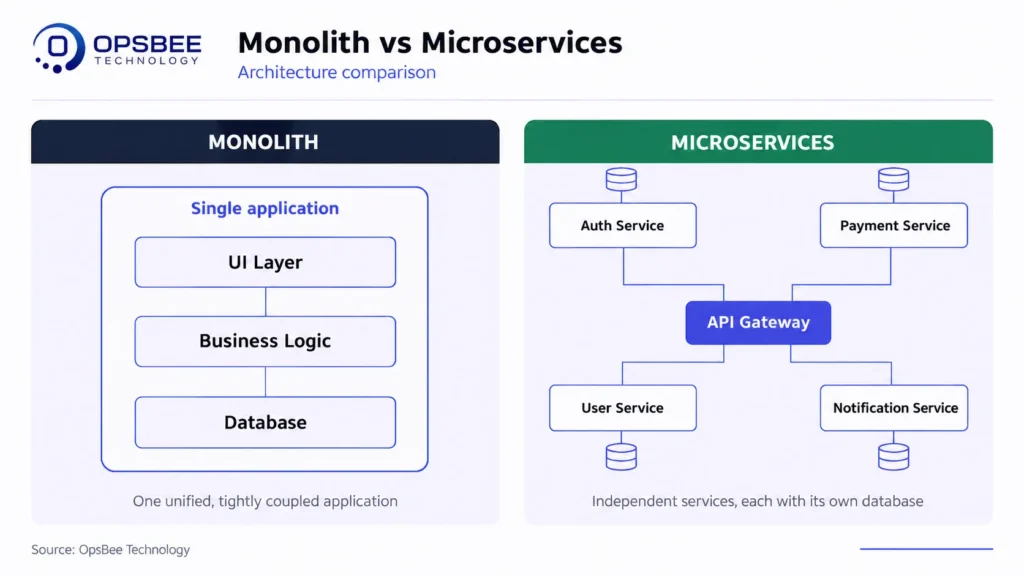
Monolithic architecture refers to an architecture where the user interface (UI), business logic, and data access layer are part of one cohesive application in the form of one single codebase.
- Single codebase, single deployment
- Easy to develop, test, and deploy in its early stages
- All the components have the same resources and scale up together
Most startups, including those who have microservices architecture currently, began as a monolith. This is the quickest path from concept to execution.
What Is Microservices Architecture?
In microservices architecture, software is divided into small services that have a defined responsibility (handling user accounts, handling payments, notifications, and more), which interact through an API.
- Each service can be developed, released, and scaled independently
- Different teams can work on individual services without affecting one another
- Issues with one service do not necessarily impact the entire system
The benefit of the independence of microservices architecture is huge—but there is a cost too in terms of its operations.
Microservices vs Monolith: Key Differences
Factor | Monolithic Architecture | Microservices Architecture |
Development Speed (early stage) | Faster to build and ship | Slower to set up initially |
Deployment | Single deployment for the whole app | Independent deployments per service |
Scaling | Scale the entire application together. | Scale individual services as needed |
Team Structure | Works well for small, single teams | Suited to multiple independent teams |
Operational Complexity | Low | Higher (monitoring, networking, orchestration) |
Fault Isolation | One failure can affect the whole app | Failures are more contained |
Best Fit | Early-stage startups, MVPs | Scaling companies with multiple teams |
When a Monolith Makes Sense for Your Startup

If you’re before product-market fit, monolithic architecture is definitely the way to go. Here are a few reasons why:
- You’re able to release new features faster without dealing with distributed systems
- Small teams (less than ~10-15 developers) don’t need extra complexity from microservices
- Your product is still being refined – you’re not ready for service boundaries that could potentially be incorrect in 3 months
- Hosting costs remain low and easier to manage
Even a well-organized monolithic architecture (also known as a “modular monolith”) will serve a startup well beyond its early phases.
When Microservices Make Sense for Your Startup
The value of microservices architecture comes into play when the following trends emerge:
- Multiple engineering teams have to deploy separately and not block each other
- Certain components within your software (for example, checkout and search) have to scale differently than the rest
- Different components of the software have to be built using different languages or by different specialist teams
- Deployments are happening often enough so that one shared deployment pipeline becomes a constraint
The most obvious candidates for a microservices transition are startups at the stage of Series B/C with dozens of developers across multiple product domains.
Signs It’s Time to Move From Monolith to Microservices

- Deployments have been getting slow, dangerous, or require some kind of a “deployment freeze”
- The changes made by one team often break the features of another team
- The code for one single component (such as image processing or searching) requires many times more CPU power than the whole application
- It takes weeks to onboard new developers because the codebase is now too big to comprehend
- You’ve created different teams for different products, but all of them use one shared codebase
If none of the above has happened to you yet, then your monolith still does its job great!
Common Mistakes When Choosing Architecture
- Adoption of microservices for the wrong reasons, because it’s the cool thing to do, not because there is a scaling issue
- Designing services based on the tech stack (“database code,” etc.) instead of designing according to business capabilities (“billing,” “user account,” etc.)
- Overlooking the ops burden running and maintaining a distributed system requires a separate skill set
- Going full-scale with microservices all at once without extracting only high-value services at first
- Failing to consider organizational factors — Conway’s Law states that your architecture will ultimately reflect your organization structure one way or another
Recommended Tools for Each Approach (2026)
Tool | Best For |
Docker | Packaging services consistently, whether monolith or microservices. |
Kubernetes | Orchestrating and scaling multiple microservices in production. |
Nginx / API Gateway (Kong) | Routing requests across microservices from a single entry point. |
Consul | Service discovery and configuration for distributed microservices. |
Prometheus + Grafana | Monitoring performance across both monoliths and microservices. |
How OpsBee Technology Helps You Choose the Right Architecture
Decision about Microservices vs Monolith needs to be done in relation with other factors like team and roadmap and current infrastructure you have. At OpsBee Technology, we assist startups in evaluating their existing infrastructure and then guiding them on future plans based on their reality and not wishful thinking.
Our related services include:
Explore our full range of services at OpsBee Technology
Final Thoughts: Architecture Should Match Your Stage, Not Your Ambition
There is no definitive “right” choice in Microservices vs Monolith there is just the right choice based on where you are at the moment with your startup. Being able to move quickly with your monolith while figuring out your product-market fit isn’t a compromise it’s the right choice at the moment. Microservices are the right choice only when scale and friction force you to do so.
This is what startups who make the wrong decision don’t understand they are choosing the right architecture for the wrong stage. An external point of view might help you find out what stage of your business you really are at.
Contact our experts at OpsBee Technology today for an architecture review that’s based on your actual growth stage, not industry hype.