

You ship a small improvement to your API: a field gets renamed to something clearer. By morning, a partner’s mobile app is crashing, support tickets are flooding in, and your team is rolling back a change that looked harmless in code review.
This is why API versioning matters. An API is a contract with everyone who depends on it, and breaking changes break trust as well as code. This guide covers the strategies and practices that let you evolve your API without surprising the people who depend on it.
Table of Contents
- Why API Versioning Matters
- What Counts as a Breaking Change?
- API Versioning Strategies Compared
- API Versioning Best Practices
- How to Deprecate an API Version Safely
- Catching Breaking Changes Automatically
- Common API Versioning Mistakes
- Recommended API Tools (2026)
- How OpsBee Technology Helps
- Final Thoughts: Treat Your API as a Promise
Why API Versioning Matters
Unlike your own application code, you can’t update every API consumer at once. Mobile apps stay installed for years, partners move on their own schedules, and some integrations are never touched again. If you change behavior without warning, those consumers fail.
Good versioning gives you two things at once: freedom to improve your API and stability for the people using it. It also reduces support load, protects revenue tied to integrations, and keeps your reputation as a reliable platform.
What Counts as a Breaking Change?
Knowing the difference is the foundation of backward compatibility.
Usually Safe (Non-Breaking) | Usually Breaking |
Adding a new endpoint | Removing or renaming an endpoint |
Adding an optional request parameter | Making an optional parameter required |
Adding a new field to a response | Removing or renaming a response field |
Adding a new optional header | Changing a field’s data type |
Improving performance | Changing error codes or response structure |
Fixing a clear bug | Changing authentication requirements |
Two cautions apply. First, adding new enum values can break strict clients that don’t expect them. Second, even a bug fix can be breaking if consumers had come to depend on the old behavior. When in doubt, treat the change as breaking.
API Versioning Strategies Compared
There’s no single correct approach. Each has trade-offs.
Strategy | Example | Pros | Cons |
URI path | /v2/orders | Obvious, easy to route and cache | Version appears in every URL |
Query parameter | /orders?version=2 | Simple to add | Easy to forget, messy caching |
Custom header | Api-Version: 2 | Clean URLs | Less visible, harder to test in a browser |
Media type | Accept: application/vnd.app.v2+json | Pure REST approach | More complex for clients |
Date-based | Api-Version: 2026-01-15 | Fine-grained, pinned per customer | Needs more tooling to manage |
For most teams, URI path versioning is the pragmatic default because it’s easy to understand, document, and route. Whichever you pick, choose one and apply it consistently.
API Versioning Best Practices
1. Design to Avoid Breaking Changes in the First Place
The best version is the one you never need. Make changes additive, and follow the tolerant reader principle: encourage clients to ignore fields they don’t recognize.
2. Use Semantic Versioning for Clarity
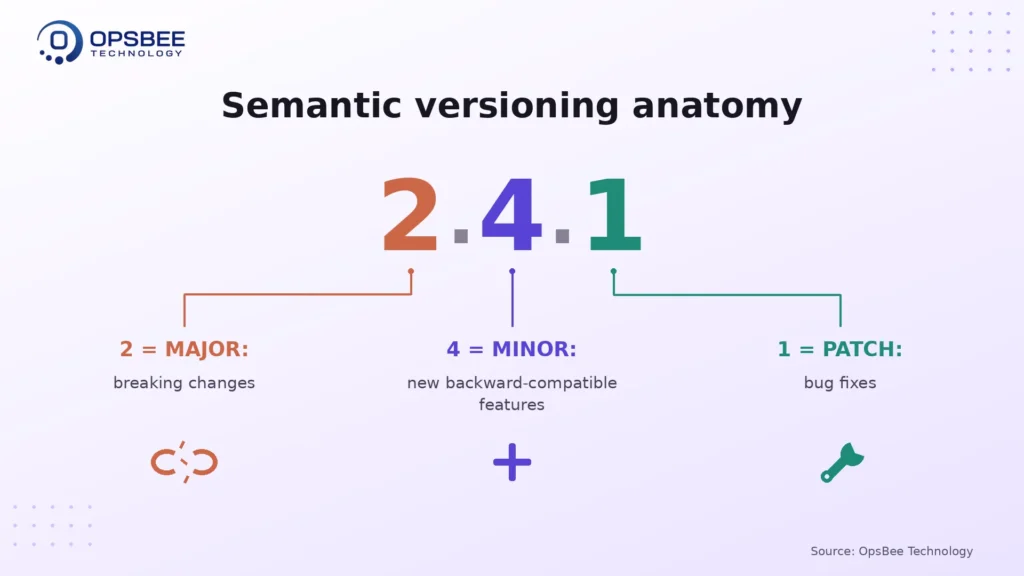
Semantic versioning uses MAJOR.MINOR.PATCH. Increase MAJOR for breaking changes, MINOR for backward-compatible features, and PATCH for fixes. Many public APIs expose only the major version in the URL (v1, v2) and track minor changes in release notes.
3. Version Only When You Must
Every live version is something you must maintain, secure, and document. Resist creating a new version for changes that can be made compatibly.
4. Document Everything With a Specification
Maintain an OpenAPI specification for each version, plus a clear changelog. Consumers should always know what changed and why.
5. Keep Versions Isolated
Structure code so versions share business logic but have separate request and response layers. This limits the cost of supporting older versions.
6. Communicate Early and Often
Announce changes through changelogs, emails, developer portals, and API response headers well before they take effect.
7. Give Consumers Migration Help
Provide migration guides, code examples, and a sandbox. The easier the move, the faster old versions retire.
8. Monitor Usage Per Version
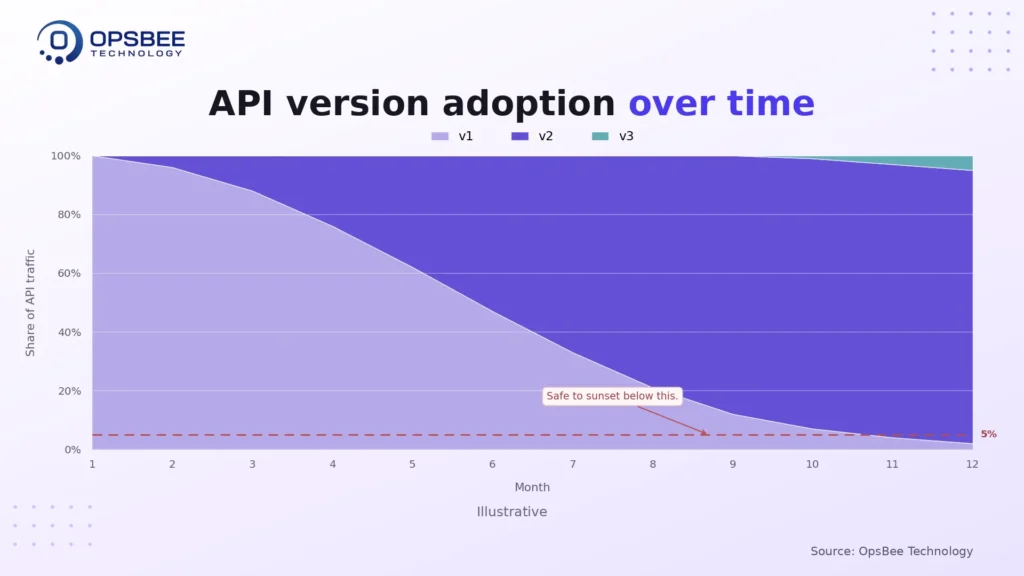
Track which consumers call which versions. You can’t safely retire a version if you don’t know who still uses it.
How to Deprecate an API Version Safely
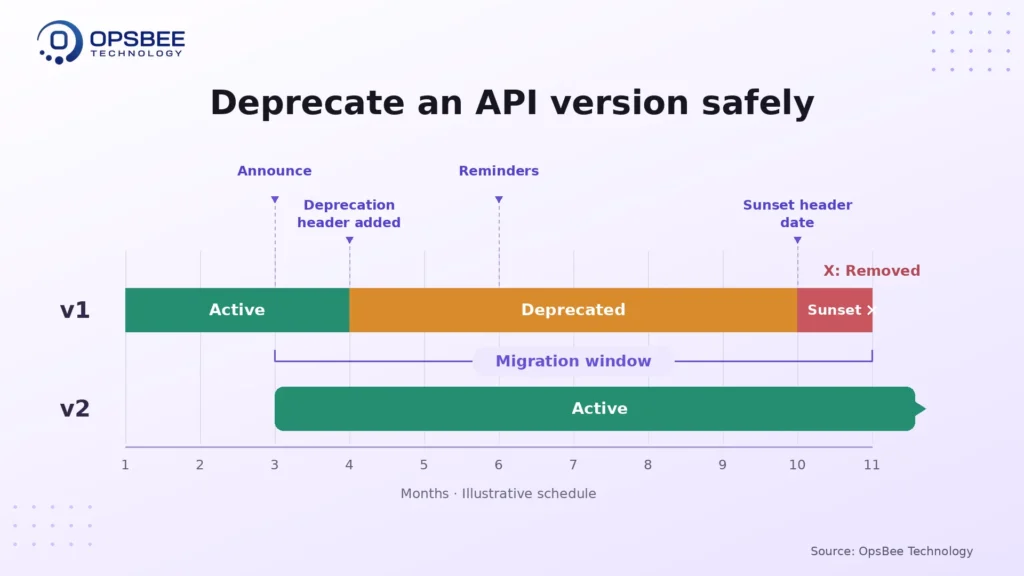
Deprecation is where many teams lose consumer trust. A careful process looks like this:
- Announce: publish the deprecation plan and timeline.
- Mark responses: add the Deprecation header, plus the Sunset header (defined in RFC 8594) showing the removal date.
- Support migration: share guides and contact heavy users directly.
- Watch traffic: monitor remaining usage of the old version.
- Warn again: send reminders as the date approaches.
- Sunset: retire the version only when traffic is minimal and the notice period has passed.
Notice periods vary by audience. Public APIs commonly give six to twelve months or more, while internal APIs can move faster. Whatever you choose, publish the date and keep it.
Catching Breaking Changes Automatically
Humans miss things in code review, so automate the check:
- Spec diffing: compare the OpenAPI file in each pull request against the published version and fail the build on breaking differences
- Contract testing: verify that provider changes still satisfy what real consumers expect
- Staging tests: run consumer test suites against new builds before release
- Gradual rollouts: use canary releases to limit the impact of surprises
Building these checks into your CI/CD pipeline turns versioning from a manual worry into a safety net.
Common API Versioning Mistakes
- Making breaking changes without a version bump
- Creating new versions for trivial changes
- Retiring versions with no notice or usage data
- Mixing versioning strategies across endpoints
- Leaving old versions unpatched and insecure
- Skipping documentation and changelogs
- Assuming internal consumers don’t need notice
Recommended API Tools (2026)
Tool | Purpose |
OpenAPI Specification | Standard, machine-readable description of your API contract. |
oasdiff | Comparing OpenAPI specs to detect breaking changes. |
Pact | Consumer-driven contract testing. |
Kong Gateway | Routing, versioning, and traffic management at the gateway. |
Postman | Documenting, testing, and sharing API collections. |
How OpsBee Technology Helps
Safe API evolution depends on strong pipelines, good automation, and reliable infrastructure. At OpsBee Technology, we help engineering teams build the delivery foundations behind dependable APIs, including automated testing in CI/CD, release automation, and cloud environments that support gradual, low-risk rollouts.
Our related services include:
Explore our full range of services at OpsBee Technology
Final Thoughts: Treat Your API as a Promise
Strong API versioning isn’t about adding version numbers everywhere. It’s about respecting the people who build on your platform. Make changes additive, communicate clearly, deprecate with care, and automate the detection of breaking changes. Your consumers will trust you more, and your team will ship improvements with less fear.
Contact our experts at OpsBee Technology today to strengthen your API delivery pipeline and release with confidence.