

Production RAG architecture is the set of components and operating practices that allow a retrieval-augmented generation system to answer questions reliably, securely, and at acceptable cost for real users. For example, A prototype can be built with a simple sequence: split documents into chunks, embed them, retrieve the most similar ones, and pass them to a language model. A production system, however, needs much more: a retrieval pipeline that keeps quality high as data grows, document ingestion that does not slow down user requests, measurable evaluation, monitoring across every stage, and controls on the cost of tokens, embeddings, and infrastructure.
Specifically, this article describes the core components of a RAG pipeline, the retrieval techniques that most affect answer quality, how to deploy RAG systems on scalable infrastructure, which evaluation and monitoring metrics to track, and the main levers for optimizing RAG costs without weakening answer quality. It is intended for engineering and platform teams planning or operating RAG applications.
Table of Contents
- What Is a Production RAG Architecture?
- Core Components of a RAG Pipeline
- Retrieval Quality: Chunking, Hybrid Search, and Reranking
- Deploying a RAG System to Production
- Monitoring and Evaluating RAG in Production
- Optimizing RAG Costs
- Production Readiness Checklist
- Common RAG Production Mistakes
- AI Platform Engineering Support from OpsBee Technology
- Conclusion: Build Production RAG with OpsBee Technology
1. What Is a Production RAG Architecture?
Retrieval-augmented generation (RAG) grounds a large language model (LLM) in external knowledge. Instead of relying only on what the model learned during training, the system retrieves relevant information from a document collection and includes it in the prompt, so answers can reflect current, private, or domain-specific data and can cite their sources.
At first, a RAG flow is often built as a simple chunk, embed, and retrieve sequence. However, engineering guides treat this approach as a proof of concept, not a production architecture. This is because retrieval design is often left vague, and that is where production systems tend to fail.
Aspect | Prototype RAG | Production RAG |
Retrieval | Vector similarity, top-k | Hybrid search, reranking, filtering |
Ingestion | Run manually or inline | Asynchronous, queued, retryable pipelines |
Evaluation | Manual spot checks | Measured against a test set with defined metrics |
Monitoring | Basic logs | Stage-level latency, quality, token, and cost tracking |
Security | Often minimal | Access control, data isolation, secrets management |
Scaling | Single instance | Autoscaling services and managed data stores |
Cost control | Not tracked | Cost per query and per successful answer measured |
2. Core Components of a RAG Pipeline
A production RAG system has two connected flows: an indexing flow that prepares knowledge, and a query flow that answers questions.
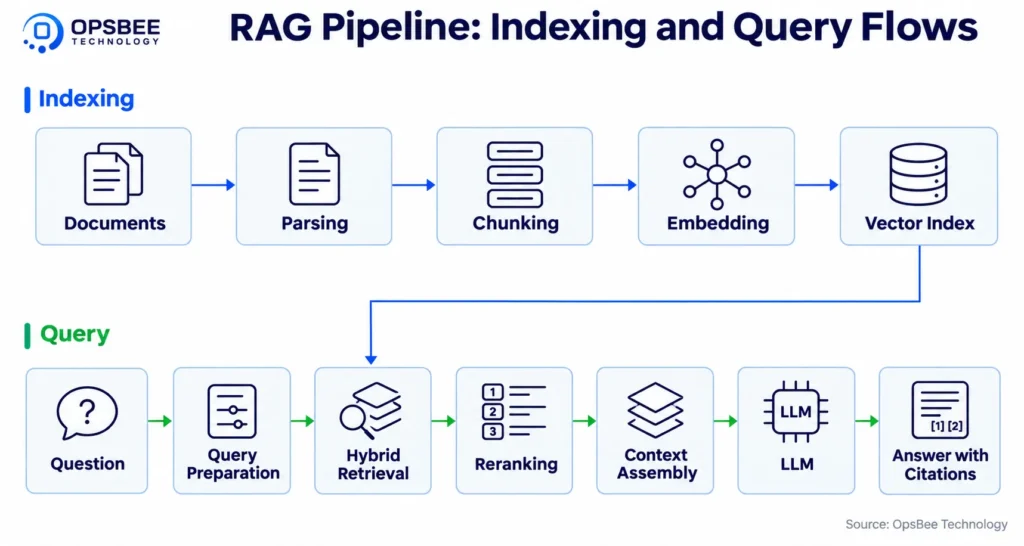
Component | Role | Production considerations |
Document ingestion | Collects and parses source documents | Handle varied formats, track document versions, use stable document IDs instead of filenames |
Chunking | Splits documents into retrievable pieces | Chunk strategy strongly affects retrieval quality |
Embedding model | Converts text into vectors | Model choice affects quality, ingestion cost, and index size |
Vector database or search index | Stores and searches embeddings, often with metadata and keyword indexes | Scalability, filtering, hybrid support, and standing infrastructure cost |
Retriever | Finds candidate chunks for a query | Combines semantic and keyword search |
Reranker | Reorders candidates by relevance | Improves precision before generation |
Context assembly | Selects and orders chunks for the prompt | Controls prompt size and relevance |
LLM | Generates the answer from the question and context | Model selection, latency, and token usage |
Orchestration and APIs | Coordinates the flow and exposes the service | Timeouts, retries, caching, and fallbacks |
Evaluation and observability | Measures quality and system behavior | Offline test sets and online monitoring |
File names are not reliable identifiers, since files can be renamed, copied, versioned, and re-uploaded. Assigning stable document identifiers supports citations, evaluation, debugging, and regression testing as documents change.
3. Retrieval Quality: Chunking, Hybrid Search, and Reranking
The quality of a RAG system is bounded by the quality of its indexed data and its retrieval. Most production improvements are made in this layer.
Chunking
Chunking is a design decision, not a default setting. Common strategies include:
- Fixed-size chunking: splits text by length, simple but can break meaning
- Recursive or structure-aware chunking: splits along headings, paragraphs, and sentences to preserve logical structure
- Semantic chunking: uses embeddings to split where topics change
Structure-aware approaches that preserve parent context are widely recommended over plain fixed-size splitting. Chunks that are too large dilute relevance, while chunks that are too small lose context.
Hybrid Search
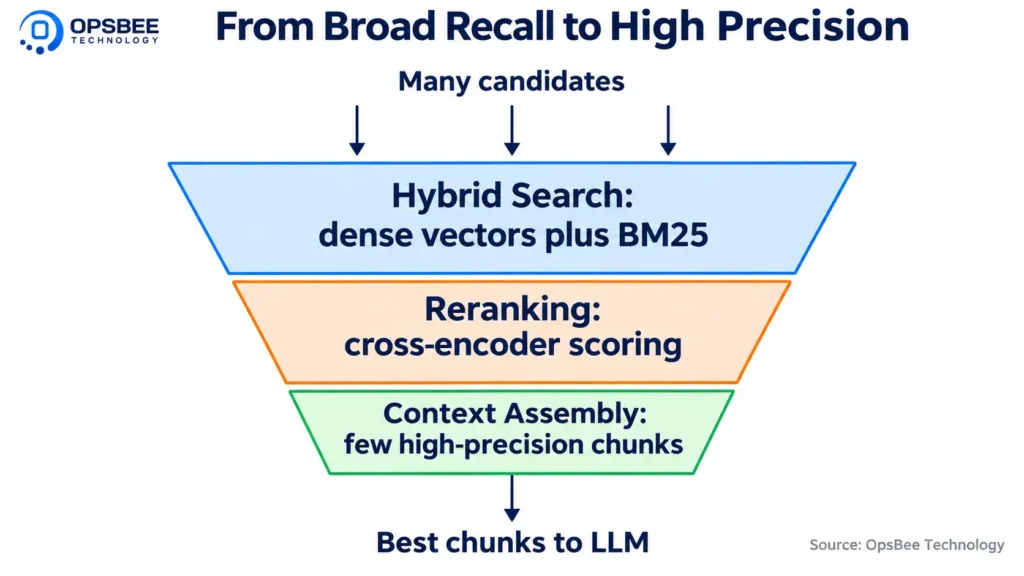
Hybrid search combines dense vector search, which captures semantic similarity, with lexical search such as BM25, which captures exact terms, codes, and domain vocabulary. Results are often merged with a technique such as Reciprocal Rank Fusion. Vector search alone can miss exact identifiers and technical terms, so hybrid retrieval is generally treated as one of the highest-value upgrades beyond a basic setup.
Reranking
Vector similarity and keyword search are recall-oriented: they retrieve many plausible candidates. A cross-encoder reranker scores each query and candidate together, which is slower but more accurate than the initial retrieval, so it is applied to a shortlist to improve final precision.
Context Assembly
More context is not automatically better. Irrelevant passages can degrade answers and increase cost. A common design is to retrieve a broad candidate set, rerank it, and send a small number of high-precision chunks to the model, ordered sensibly and within a defined token budget.
Symptom | Likely cause | Typical remedy |
Right topic, wrong details | Chunks too large or noisy | Smaller or structure-aware chunks, add reranking |
Misses exact terms or codes | Dense-only retrieval | Add keyword and hybrid search |
Confidently wrong answers | Low faithfulness | Tighten the prompt, require grounding, allow “I don’t know” |
Slow responses | Too much retrieved context or slow stages | Reduce top-k, set stage timeouts, cache |
4. Deploying a RAG System to Production
Separate Ingestion from the Request Path
Document processing, such as parsing, chunking, and embedding, should run in the background instead of inside user requests. A common pattern is to place ingestion events on a queue, process documents in batches, retry failures, and route repeatedly failing messages to a dead-letter queue for review. This keeps query latency predictable and prevents large uploads from slowing the application.
Containerize and Orchestrate
Running RAG services as containers on Kubernetes allows each component, such as the API, retriever, reranker, embedding service, and model-serving layer, to scale independently. Useful capabilities include:
- Autoscaling based on request load or queue depth
- Load balancing and high-availability deployments for inference and retrieval services
- Canary or gradual releases so that changes to prompts, models, or indexes are exposed to a small share of traffic first
- GPU scheduling where embedding or generation models are self-hosted
Version Everything
Treat prompts, embedding models, chunking settings, and indexes as versioned artifacts. Changing the embedding model typically requires re-embedding the corpus, so index versions should be tracked and releases should be reversible. Keep a regression test set so that changes can be compared against a known baseline.
Handle Multi-Tenancy and Access Control
If different users or customers should see different documents, enforce access rules at retrieval time, so that restricted content is never placed in a prompt for an unauthorized user. Isolation between tenants is best implemented at the infrastructure or data layer, not through ad hoc logic scattered through application code.
Secure the Pipeline
- Store API keys and credentials in a secrets manager
- Treat retrieved content as untrusted input, since documents can contain instructions that attempt to manipulate the model, a widely recognized risk for LLM applications
- Limit what data the model can see and what actions it can trigger
- Log carefully, excluding sensitive data
Plan for Failure
Set timeouts on every stage, use fallbacks when retrieval or generation fails, and design the application to degrade gracefully, for example by returning retrieved sources when generation is unavailable.
5. Monitoring and Evaluating RAG in Production
Production RAG without evaluation is difficult to improve, because failures are often subtle: the system still produces fluent answers that may be wrong or unsupported.
Offline Evaluation Metrics
Build a test set of representative questions with expected relevant sources, even 50 to 100 examples, and measure the following. Frameworks such as RAGAS provide these metrics.
Metric | What it measures |
Faithfulness | Whether every claim in the answer is supported by the retrieved context, which helps detect hallucination |
Answer relevancy | Whether the answer actually addresses the question |
Context precision | Whether the retrieved chunks are relevant to the question |
Context recall | Whether the retrieved chunks include what is needed to answer |
Recall@K and MRR | How highly the relevant sources are ranked in the results |
Evaluate retrieval separately from generation. When answer quality drops, separating the two shows whether the problem is in retrieval or in the model’s use of the context.
Online Monitoring
Area | What to track |
Latency | Time per stage: gateway, retrieval, reranking, generation, post-processing, plus time to first token |
Quality signals | User feedback, citation click-through, “no answer” rates, sampled answer reviews |
Retrieval behavior | Number of chunks retrieved, empty or low-score results, query categories |
Token usage | Input and output tokens per request, tracked separately |
Reliability | Error rates, timeouts, retry counts, queue depth |
Cost | Cost per query and cost per successful answer |
Data freshness | Ingestion lag, failed documents, index age |
Drift | Changes in query patterns, document content, or quality metrics over time |
Distributed tracing across the full request path, from gateway to model to retrieval to post-processing, makes it possible to see which stage causes latency or errors. For more on this practice, see OpsBee’s Monitoring & Observability Services. Changes should be validated with controlled comparisons on the evaluation set before and after release.
6. Optimizing RAG Costs
RAG costs come from several sources, and the largest are often not where teams first look.
Cost driver | What affects it |
Retrieved context tokens | Number and size of chunks sent to the model on every request |
Model selection | Which LLM handles each request; output tokens usually cost more than input tokens |
Embeddings | Number of documents and chunks, embedding model, and how often the corpus is re-indexed |
Vector storage and search | Index size, embedding dimension, memory, replicas, query volume, and standing infrastructure cost |
Compute and GPUs | Self-hosted models, rerankers, and embedding services |
Operations | Monitoring, storage, and network usage |
Cost Optimization Levers
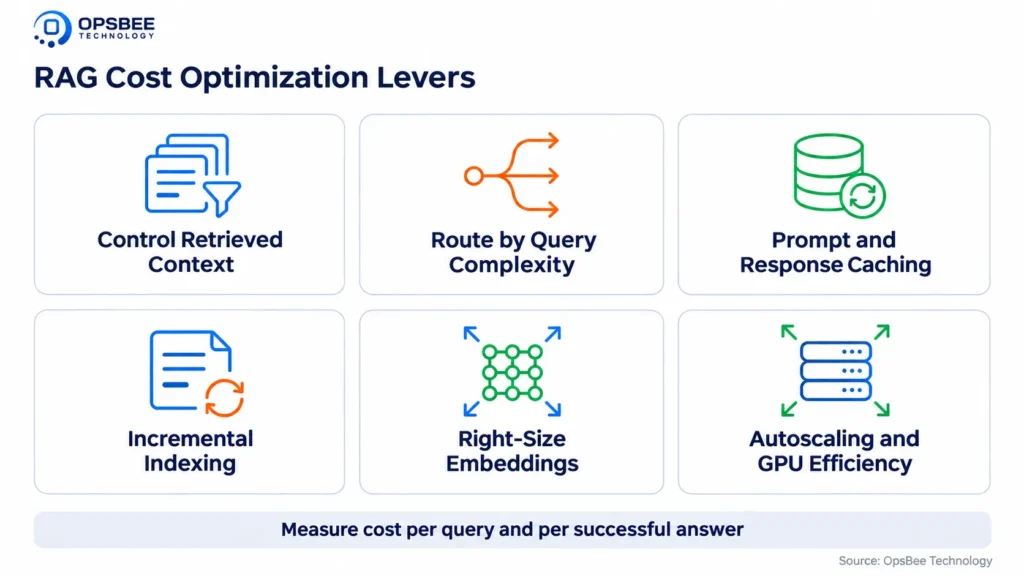
Measure Cost Before Optimizing: Track cost per query and cost per successful answer, along with input and output tokens, retrieved chunk count, embedding volume, and vector database usage. Without these figures, optimization is guesswork.
Control Retrieved Context: Because every retrieved chunk adds input tokens to every call, tuning top-k and chunk size is often the largest RAG-specific lever. Reranking allows fewer, better chunks to be sent, and context compression can shorten large passages.
Route Requests by Complexity: Not every question needs the most capable model. Directing simple lookups to a smaller model and reserving larger models for complex synthesis reduces spend while preserving quality where it matters. Validate routing decisions against the evaluation set.
Use Prompt Caching: In RAG applications, large parts of the prompt, such as system instructions, are identical from call to call. Prompt caching, where the model provider supports it, avoids reprocessing that repeated content.
Use Response and Semantic Caching Carefully: Caching answers to repeated or similar questions reduces repeated inference, especially for common questions. It requires attention to similarity thresholds, invalidation rules when source data changes, and conversational context, since similar-looking questions can need different answers.
Index Incrementally: Detect changed documents and re-embed only what changed instead of rebuilding everything. Process documents in batches.
Right-Size Embeddings and Storage: Smaller embedding dimensions and efficient indexes reduce storage, memory, and latency, at the cost of slightly less precise matching, so test the quality impact.
Reduce Output Length: Prompts that request concise answers reduce output tokens.
Optimize Infrastructure: Autoscaling, efficient GPU scheduling, and the use of spot capacity for interruption-tolerant workloads, such as batch embedding, reduce compute cost. Ongoing cost visibility and governance are part of FinOps & Cost Optimization.
Each change should be evaluated for its effect on both cost and answer quality, since savings that degrade accuracy are not real savings.
7. Production Readiness Checklist
Area | Check |
Retrieval | Hybrid search and reranking evaluated against a test set |
Chunking | Strategy chosen and benchmarked, stable document IDs in use |
Ingestion | Asynchronous, batched, retryable, with a dead-letter queue |
Deployment | Containerized, autoscaled, with gradual release capability |
Versioning | Prompts, models, and indexes versioned and reversible |
Security | Access control at retrieval, secrets managed, retrieved content treated as untrusted |
Evaluation | Offline metrics defined: faithfulness, relevancy, context precision and recall |
Monitoring | Stage-level latency, token use, errors, and quality signals tracked |
Cost | Cost per query and per successful answer measured |
Failure handling | Timeouts, fallbacks, and graceful degradation in place |
Freshness | Ingestion lag and index age monitored |
8. Common RAG Production Mistakes
Mistake | Consequence | Better practice |
Relying on top-k vector similarity alone | Missed exact terms, noisy context | Add hybrid retrieval and reranking |
Sending too many chunks to the model | Higher cost and degraded answers | Budget context, favor precision |
Running ingestion inside user requests | Slow, unpredictable responses | Process documents asynchronously |
No evaluation set | Quality changes go unnoticed | Build a test set and track metrics |
Evaluating only the final answer | Cannot tell retrieval from generation problems | Measure retrieval and generation separately |
Using the largest model for every query | Unnecessary spend | Route by query complexity |
Re-indexing the entire corpus on every change | High embedding cost | Index incrementally |
Ignoring access control at retrieval | Data exposure across users | Enforce permissions before content reaches the prompt |
Caching without invalidation rules | Stale or incorrect answers | Define invalidation and test thresholds |
No cost tracking | Surprise bills and unclear tradeoffs | Track cost per query and per successful answer |
9. AI Platform Engineering Support from OpsBee Technology
OpsBee Technology provides AI Platform Engineering services to help organizations build, deploy, and scale AI workloads on a Kubernetes-native platform across AWS, Azure, and Google Cloud. Capabilities relevant to production RAG include:
- LLMOps and generative AI infrastructure: deploying and managing large language models, vector databases, and Retrieval-Augmented Generation pipelines on scalable infrastructure
- Production-ready model deployment: Kubernetes-based serving with autoscaling, load balancing, canary releases, and high-availability inference
- GPU infrastructure and AI compute optimization: Kubernetes GPU orchestration, NVIDIA GPU Operator integration, intelligent autoscaling, and cost-efficient cloud resource management
- AI model monitoring and drift detection: tracking model performance, detecting prediction drift, and monitoring inference metrics using modern observability tools
- MLOps pipeline automation: automating model training, validation, deployment, and monitoring
OpsBee supports AWS, Azure, Google Cloud, hybrid cloud, and multi-cloud environments. For the underlying container platform, see Kubernetes Platform Engineering, and for platform security and governance, see Cloud Security & Compliance. The scope of any engagement depends on the architecture and requirements, so contact the OpsBee team to discuss details.
10. Conclusion: Build Production RAG with OpsBee Technology
Production RAG architecture is defined less by the model than by the system around it. Strong retrieval through well-chosen chunking, hybrid search, and reranking determines answer quality. Asynchronous ingestion, scalable deployment, versioned artifacts, and access control determine reliability and security. Measured evaluation and stage-level monitoring make quality visible, and disciplined cost tracking, context budgeting, model routing, caching, and incremental indexing keep spend proportional to value. Teams that treat these as engineering requirements from the start avoid the gap between a convincing demo and a dependable service.
For organizations moving RAG applications into production, OpsBee Technology offers AI Platform Engineering services covering LLMOps, vector database and RAG pipeline infrastructure, production-ready model deployment, GPU optimization, and model monitoring on AWS, Azure, and Google Cloud. Talk to our AI platform experts to review your architecture and plan a production-ready approach.